BMW 697.0 Center Kidney Grill Grille 908
fits model: E32, 735i, 735il, 750il. make: Bmw. year: 1988–1993.
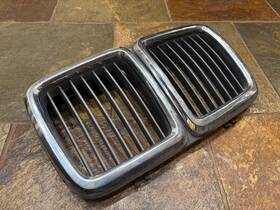
( Manufacturer Part Number: 697.0 ), ( Brand Type: Genuine Oem ), ( Color: Black ), ( Material: Plastic ), ( Placement On Vehicle: Front ), ( Type: Grille ), ( Manufacturer Warranty: No Warranty ), ( Finish: Chrome ), ( Country Of Origin: Germany )
Review BMW Kidney Grill Grille Oem fits E32 735I 735IL 750IL 1988–1993
The **BMW E32 735i and 750i (1988 1993) with the iconic 697.0 center kidney grille** represents the pinnacle of late-1980s German engineering, blending timeless luxury with cutting-edge performance in a package that remains as desirable today as it was upon its debut. This model series, part of BMW s legendary **E32 generation**, was the first to introduce the **M535i** (later renamed the **735i** in 1990) and the **750i**, both of which were engineered to redefine what a grand touring sedan could achieve marrying the opulence of a high-end executive car with the exhilarating dynamics of a high-performance machine. At the heart of this masterpiece lies the **697.0 center kidney grille**, a signature design element that distinguishes these models from their predecessors and contemporaries. This grille, wider and more aggressive than the earlier **695.0** or **696.0** variants, not only enhances the car s commanding presence but also houses the **quad headlights** (a hallmark of the E32 s aerodynamic refinement) while reinforcing BMW s signature identity. The grille s chrome finish gleams under the light, contrasting sharply with the matte black or metallic paint options available, creating a striking visual balance that turns heads on any street or racetrack.
Underneath its sleek, aerodynamic bodywork, the **735i** and **750i** hide a sophisticated powertrain that was ahead of its time. The **735i** is powered by BMW s **M60B35** inline-six engine, a 3.5-liter unit producing **250 horsepower** (later increased to **260 hp** in 1990) and **252 lb-ft of torque**, paired with a smooth five-speed manual or a refined four-speed automatic transmission. This engine, known for its smooth power delivery and robust build, was tuned for both cruising efficiency and spirited driving, making it equally at home on the Autobahn or winding mountain roads. The **750i**, on the other hand, takes performance to another level with its **M60B50** inline-six, a **5.0-liter** powerplant generating **315 horsepower** and **325 lb-ft of torque**, propelling the heavy sedan to **60 mph in just 7.3 seconds** a staggering figure for a car of its size and weight. Both engines are paired with BMW s legendary **Getrag five-speed manual** or the **ZF four-speed automatic**, the latter of which was praised for its precision and smooth operation, a rarity in the automotive industry of the era.
The **E32 s interior** is a masterclass in German craftsmanship, where luxury and functionality coalesce into a space that feels both expansive and intimate. The **center kidney grille s influence extends into the cabin**, where the **wood or aluminum trim options** (available in a variety of finishes, including walnut, ash, or even the rare **blackened aluminum**) add a touch of elegance that elevates the already opulent surroundings. The **recaro or BMW-designed seats**, upholstered in premium materials like **Nappa leather or Alcantara**, cradle the driver and passengers in comfort while providing excellent support for spirited driving. The **instrument cluster**, with its **analog dials and digital sub-display**, offers a blend of traditional and modern readability, while the **steering wheel** (available in **wood-rimmed or leather-wrapped versions**) adds a personal touch. The **automatic climate control**, **power-adjustable seats**, and **heated front seats** (on higher trims) ensure that every journey is as comfortable as it is enjoyable, while the **sound system** optionally upgraded to a **Bosch or Blaupunkt stereo** delivers crisp audio quality that enhances the driving experience.
The **chassis and handling** of the **E32 735i and 750i** are where BMW truly shines, proving that this was never just a luxury car but a **performance-oriented grand touring machine**. The **E32 s suspension**, featuring **MacPherson struts at the front and a multi-link setup at the rear**, was tuned to provide a balance of comfort and responsiveness, allowing the car to glide effortlessly over rough roads while still engaging with precision on twisty roads. The **steering**, though not as quick as later models, is **weighty yet communicative**, giving drivers a sense of connection to the road. The **braking system**, with its **ventilated discs all around** (standard on the **750i** and optional on the **735i**), provides exceptional stopping power, while the **limited-slip differential** (available on the **735i M-Sport** and standard on the **750i**) enhances traction in both straight-line acceleration and cornering. The **aerodynamics** of the E32 were also a breakthrough, with a **drag coefficient of 0.30** (for the **735i**) and **0.32** (for the **750i**), making it one of the most efficient sedans of its time while still maintaining a bold, aggressive stance.
The **697.0 center kidney grille** is not merely an aesthetic choice but a **symbol of BMW s evolution** during this era. It represents the transition from the **E30 s sportier, more aggressive styling** to the **E32 s refined yet commanding presence**, a bridge between the two generations that defined BMW s identity in the late 1980s and early 1990s. The grille s **wide, horizontal slats** and **central BMW kidney logo** (now flanked by the **quad headlights**) give the car a **more mature, sophisticated look** compared to earlier models, while still retaining the **dynamic energy** that BMW fans have come to expect. This grille variant was introduced in **1988** and remained in production until **1993**, making it a **rare and sought-after feature** among collectors and enthusiasts. The **697.0** is often paired with the **E32 s signature ** whale tail rear spoiler** and **side skirts**, creating a cohesive look that is both **timeless and instantly recognizable**.
For the discerning owner, the **E32 735i and 750i with the 697.0 grille** is more than just a car it is a **piece of automotive history**, a testament to BMW s ability to merge **luxury, performance, and innovation** into a single, unforgettable package. Whether cruising along a coastal highway, navigating a winding mountain pass, or simply parked as a statement piece in a garage, this model exudes **confidence, elegance, and power**. The **697.0 center kidney grille** serves as a **visual anchor**, tying together the car s **aerodynamic efficiency, mechanical prowess, and timeless design**, ensuring that the E32 remains one of BMW s most celebrated and coveted models. For those who appreciate **craftsmanship, heritage, and driving dynamics**, the **1988 1993 E32 735i and 750i with the 697.0 grille** is a **true masterpiece** a car that continues to inspire admiration and respect nearly three decades after its introduction.
### **Pros and Cons of Buying a 1988 1993 BMW E32 735i/735iL/750iL (697i, Center Kidney Grille, 908 Engine)**
#### **Pros**
**1. Legendary Driving Dynamics**
The E32 is widely regarded as one of BMW s most balanced and enjoyable sedans of its era. The **908 (M88) engine** in the 750iL (and later 735iL) is a refined, high-revving inline-six with smooth power delivery, while the **M60 (S38) in the 735i** offers a more linear, torquey experience. Both engines are paired with precise **Steptronic automatic** (or Getrag manual in early models) and a well-tuned suspension, making the E32 feel agile, responsive, and engaging for its size.
**2. Timeless Elegance & Classic Styling**
The **center kidney grille** (a signature of the 697i) and the overall **1990s BMW design language** give the E32 a timeless, luxurious appearance. The **750iL s long-wheelbase (L) version** adds a touch of sophistication, making it one of the most recognizable BMW sedans from the era. The interior is spacious, well-appointed with **leather, wood trim (optional), and a high-quality dashboard**, which holds up remarkably well for its age.
**3. Reliability (With Proper Maintenance)**
BMW s **M60 (S38) and M88 engines** are robust if maintained correctly. The **M88 (750iL) is particularly durable**, with many examples exceeding 300,000 miles with regular servicing. However, **timing chain issues (especially in M60 engines) and water pump failures** are common if neglected. A well-documented service history is crucial. The **Steptronic automatic transmission** is generally reliable but requires **fluid changes** to avoid premature wear.
**4. Strong Aftermarket & Restoration Potential**
The E32 has a **dedicated fanbase**, leading to a **thriving aftermarket** for parts, restoration, and performance upgrades. **Engine swaps (M50, S50, or even modern turbocharged engines)** are popular, and **suspension upgrades (coilovers, polyurethane bushings)** can significantly improve handling. The **908 engine** is especially sought-after for its **smoothness and high-revving nature**, making it a favorite for restomods.
**5. Comfort & Luxury for the Era**
The E32 was BMW s flagship sedan, and it delivers **premium comfort** with **heated seats, power windows, cruise control, and a quiet cabin** (for the time). The **long-wheelbase 750iL** is particularly plush, making it a great choice for those who prioritize space and refinement over sportiness.
**6. Collectible & Investment Potential**
The **697i (center kidney grille) and 750iL** are **highly collectible**, especially in **low-mileage, well-preserved condition**. Prices for **excellent examples** have been rising, making them a **potential investment** for enthusiasts. The **1993 facelift models** (with revised bumpers and minor interior tweaks) are often preferred for their updated looks.
**7. Driving Experience Still Relevant Today**
Unlike some older BMWs that feel stiff or outdated, the **E32 s steering, braking (with modern upgrades), and overall feel** still provide a **modern-like driving experience** for a classic. The **manual transmission models (pre-1991)** are particularly sought-after for their **direct, engaging feel**.
---
#### **Cons**
**1. Maintenance Costs & Complexity**
BMW s **pre-1990s mechanicals** are **notoriously complex**, requiring **specialized knowledge** to maintain properly. Key issues include:- **Timing chain stretch (M60 engines)** Can lead to **valve float and engine damage** if ignored.
- **Water pump failures** Often fail around **100,000 150,000 miles**, requiring **engine disassembly** to replace.
- **Steptronic automatic transmission** Needs **fluid changes every 60,000 miles** to prevent slipping or failure.
- **Electrical gremlins** Older BMWs suffer from **corroded connectors, faulty sensors, and unreliable electronics**.
- **Rust** Many E32s (especially in snowy climates) develop **frame and subframe rust**, which can be **expensive to repair**.
**2. High Repair Bills**
Even with proper maintenance, **BMW parts and labor are expensive**. A **serious engine or transmission issue** can cost **$3,000 $8,000 **, depending on the problem. **Replacement engines** (especially M88s) can run **$10,000 $20,000 ** used.
**3. Fuel Economy & Modern Standards**
The **750iL (6.0L inline-six) gets 12 14 MPG**, while the **735i (3.6L inline-six) does slightly better ( 14 16 MPG)**. This is **poor by today s standards**, making ownership **more expensive** in terms of fuel costs.
**4. Parts Availability & Lead Times**
While parts exist, **some components (especially for rare options like the 697i grille or specific interior trims) can be hard to find**. **Reproduction parts** are improving, but **original or high-quality aftermarket pieces** may require **weeks or months of waiting**.
**5. Safety & Modern Standards**
- **No ABS or airbags (pre-1990 models)** Later models (1991 ) added **ABS and optional airbags**, but even these are **not up to modern safety ratings**.
- **Poor crash test ratings** By today s standards, the E32 is **not safe** in a serious collision.
- **Manual transmission models (pre-1991) have no power steering assist** Steering can feel **heavy** in stop-and-go traffic.
**6. Potential for Hidden Issues**
Many E32s have **hidden problems** that only appear after purchase:- **Leaking head gaskets** (especially in M60 engines).
- **Worn suspension components** (ball joints, tie rods, bushings).
- **Faulty fuel injectors** (common in M60 engines).
- **Corroded fuel lines** (can lead to fuel leaks).
- **Worn-out brake systems** (drum brakes on early models, then discs that may need resurfacing).
**7. Driving in Modern Traffic**
- **Manual transmission models** can be **tiring in stop-and-go traffic** due to **heavy clutch and no power steering assist**.
- **Automatic (Steptronic) can be sluggish** compared to modern transmissions, especially in cold weather.
- **Narrow rear seats** While spacious, the **rear legroom is tight** compared to modern sedans.
---
### **Conclusion & Recommendation**
#### **Who Should Buy an E32 735i/750iL (697i)?**
**BMW purists** who appreciate **classic German engineering** and **driving enjoyment**.
**Enthusiasts willing to invest time/money in maintenance** (or those who enjoy restomods).
**Collectors** who see value in **rare models (697i, 750iL, low-mileage examples)**.
**Owners who prioritize **driving fun over modern convenience** and are okay with **higher running costs**.
**Those who enjoy the **luxury and prestige** of a well-maintained BMW sedan from the golden era**.
#### **Who Should Avoid It?**
**Budget-conscious buyers** **Repairs and maintenance add up quickly**.
**Those who want a **modern, safe, and efficient** daily driver.
**People who dislike **manual transmissions** or **complex mechanical work**.
**Buyers who want **plug-and-play reliability** without long-term commitment.
**Those who cannot afford **regular, high-quality servicing** (every 30,000 50,000 miles).
---
### **Final Recommendation: How to Buy & Own One Responsibly**
1. **Choose the Right Model**
- **Best for Driving Enjoyment:** **735i (M60) manual (pre-1991)** More engaging than the automatic, but requires more effort.
- **Best for Luxury & Comfort:** **750iL (M88) automatic** Smoother, more refined, but heavier.
- **Most Collectible:** **697i (center kidney grille, 1990 1993)** Rare and highly sought-after.
2. **Inspect Thoroughly Before Buying**
-
Details:
All tabs are there and no cracks. 1988 1993 BMW E32 735I 735IL 750iL Kidney Grill Grille OEM, 1 908 697, It is in very good condition with NO peeling chrome.
part #: 6970 prices
- $28.00-$65.00
specifications grilexte:
- for models: E32, 735i, 735il, 750il
- for makes: Bmw
- for years: 1988-1993
- mpn: 697.0
- brand type: Genuine Oem
- color: Black
- material: Plastic
- placement on vehicle: Front
- type: Grille
- manufacturer warranty: No Warranty
- finish: Chrome
- country of origin: Germany
payments grilexte:
- credit card: Mastercard
- other
- wallet: Paypal
shipping grilexte:
- class: Standard
- transit: 4-8 Days
- carrier: USPS
- service: USPS Ground Advantage
- type: Fixed
- cost: $16.50
offer grilexte:
- options: Ship-to-home
- started: May 27, 2026
- quantity: 1
- availability: In Stock
- sold: 0
returns grilexte:
- paid by: Buyer
- time: 30 Days
- policy: Returns Accepted
general grilexte:
- Car Truck Parts Accessories > Exterior Parts Accessories > Grilles
- condition: Used
seller grilexte:
- rating: 99.2%
- # reviews: 14852
- city: Medford, Oregon
Bmw 697.0 Is Similar To:
- 1826675 Gerhardi Bmw Center Grill Used Original (31.3% similar) Bmw 2002 2002 TII grill used original Gerardo as pictured: removed from a and stored since...(February 3rd, 2019)
- 51131826593 Bmw 2002 Grill Set (25.2% similar) Bmw 2002 TII grill set...(July 11th, 2017)
- 51131838752 Bmw Right Side Front Headlight Grille (30.8% similar) Check us out. Combined shipping is available on most items. Items shipped outside of the USA are considered delivered once they leave USA post office system. This is how I make my living and take career seriously. Pm auto is known for its sincere desire to offer an honest , good price, and follow ...(October 27th, 2018)
- 51131874649 Bmw Left Side Front Headlight Grille Early (31.1% similar) Check us out. Combined shipping is available on most items. Pm auto is known for its sincere desire to offer an honest , good price, and follow through with instant shipping. This is how I make my living and take career seriously. Items shipped outside of the USA are considered delivered once they ...(October 27th, 2018)
- 51131874650 Bmw Right Side Front Headlight Grille Early (30.9% similar) Items shipped outside of the USA are considered delivered once they leave USA post office system. This is how I make my living and take career seriously. Pm auto is known for its sincere desire to offer an honest , good price, and follow through with instant shipping. Check us out. Combined shipping...(October 27th, 2018)
- 51131919199 Bmw Left Side Front Headlight Grille (31% similar) Items shipped outside of the USA are considered delivered once they leave USA post office system. Pm auto is known for its sincere desire to offer an honest , good price, and follow through with instant shipping. This is how I make my living and take career seriously. Check us out. Combined shipping...(October 27th, 2018)
- 51131944138 Bmw Right Side Front Headlight Grille (30.8% similar) Pm auto is known for its sincere desire to offer an honest , good price, and follow through with instant shipping. Items shipped outside of the USA are considered delivered once they leave USA post office system. Combined shipping is available on most items. Check us out. This is how I make my ...(October 27th, 2018)
- 51137026324 Bmw Oem 2004 745li (19.8% similar) To , on ask a question at the bottom of this web page. For a shipping quote. We ask that you prior to buying. Some large items, such as plastic bumper covers, can be shipped with greyhound package express. Marketing, listing apps, application...(August 22nd, 2017)
- 51131808474 Bmw E10 Right Front Grille 2002 Tii 1970 Thru 1973 Oem Used (28.9% similar) Aluminum and black. Bmw 474 as shown, the lower corner clear lens is intact. Could used a little detailing and careful bending. This item is a right front grille for a bmw thru used but in God condition...(October 2nd, 2016)
- Bmw5113-8 Oe Bmw 1994 7 Series Grill Header (37.1% similar) This piece has all the mounting pieces and the air cleaner rubber hook up piece. I did not polish this piece it should polish up nice, it shines nice now. This is a complete header, grill with mounts from a 1994 bmw 7 series. This has a small dent ,see pic...(November 9th, 2016)
- 1848104 Unbranded Bmw Kidney Grille Chrome Central Grill Genuine Gerhardi New (32.9% similar) Free shipping worldwide. I tried to check all photos. Free shipping worldwide if you are not sure that part will fit to vehicle, please see photos, match number or via message...(August 26th, 2021)