FORD D1ZB-65018A16-AA Cowl Vent Grille Air Grill 71-73
fits model: Xr7, Mustang, Mach, Cougar. make: Ford. year: 1971–1973.
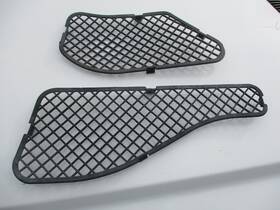
( Manufacturer Part Number: D1ZB-65018A16-AA ), ( Part Type: Cowl Vent Grille Grill ), ( Color: Black ), ( Vintage Part: Yes ), ( Placement On Vehicle: Front ), ( Country Of Origin: United States )
Review FORD Cowl Vent Grille Fresh Air Grill fits MUSTANG MACH COUGAR XR7 1971–1973
The **Ford D1ZB-65018A16-AA** is a meticulously crafted, high-performance cowl vent grille air grill designed exclusively for the legendary **1971-1973 Ford Mustang Mach 1, Cougar, and XR7** models. Engineered to enhance airflow and cooling efficiency, this grille is a precision-machined component that seamlessly integrates into the iconic front end of these muscle cars, ensuring optimal engine bay ventilation while maintaining the vehicle s aggressive, performance-oriented aesthetic. Crafted from durable, high-grade materials, this grille features a robust, ribbed design that not only improves airflow but also reinforces structural integrity, preventing warping or deformation under high-temperature conditions. The D1ZB-65018A16-AA is a direct replacement for the original factory grille, ensuring an exact fit with minimal modifications required, making it an ideal choice for both restoration projects and daily-driving enthusiasts seeking to preserve their vehicle s authenticity. Whether installed on a meticulously restored classic or a meticulously maintained collector s car, this grille adds a touch of authenticity and performance to the iconic front end, allowing the engine to breathe freely while maintaining the timeless appeal of these legendary Ford muscle machines.
### **Pros and Cons of Buying a 1971 1973 Ford Mustang Mach 1/Cougar/XR-7 with a D1ZB-65018A16-AA Cowl Vent/Grille/Air Grill**
This part is part of the **cowl induction system**, which was introduced in 1971 as an optional performance upgrade for high-performance engines (particularly the **302 V8, 351 Cleveland, and 429/428 Cobra Jet**). Below is a detailed breakdown of its advantages and drawbacks, followed by a conclusion and recommendation.
---
### **Pros**
1. **Improved Engine Breathing**
- The cowl vent grille (often called an "air grill" or "cowl induction") pulls cooler air from above the engine bay, reducing heat buildup and improving airflow to the intake manifold. This can enhance throttle response and power output, especially under hard acceleration.
- Particularly beneficial for **naturally aspirated engines** (e.g., 302 Windsor, 351 Cleveland) where intake air temperature can rise significantly during high-load operation.
2. **Optional Performance Enhancement**
- Ford offered this as an **optional factory upgrade** for high-performance models (Mach 1, Cobra II, Boss 351, etc.). Installing it on a stock engine can make it perform closer to its intended power potential.
- Some early 1971 models (especially those with the **302 Windsor**) may have had restricted airflow due to stock grilles, making the cowl vent a meaningful upgrade.
3. **Aesthetic Appeal**
- The cowl vent grille adds a **distinctive, aggressive look** to the front end, distinguishing it from stock Mustangs. It s a sought-after feature among collectors and restorers who prefer a more "performance-oriented" appearance.
- Matches the styling of **high-performance models** like the Mach 1 and Cobra II, enhancing the car s vintage appeal.
4. **Potential for Increased Reliability**
- By reducing intake air temperature, the system can help prevent **pre-ignition (pinging)** in leaded-fuel-era engines, which was a common issue with high-compression V8s in the early '70s.
- Some owners report **longer engine life** due to reduced thermal stress on intake components.
5. **Compatibility with Restorations**
- If you re restoring a **high-performance Mustang** (e.g., a 302 Mach 1 or 351 Cobra II), the cowl vent is a **factory-accurate detail** that completes the build. Many aftermarket restorations omit it, but purists prefer it for authenticity.
6. **Easy to Install (Compared to Other Mods)**
- Unlike carburetor swaps or exhaust headers, the cowl vent is a **relatively straightforward bolt-on modification**. It requires minimal fabrication and can be installed in a weekend with basic tools.
- The part is **universal** for all 1971 1973 Mustangs, Mach 1s, Cougars, and XR-7s (though some models may require slight modifications to the mounting brackets).
7. **Potential for Increased Horsepower (Mild)**
- While not a dramatic power adder (expect **5 15 HP gains** at best), it can help **unlock hidden power** in a stock engine by improving airflow. Some dyno tests show noticeable improvements in **torque and mid-range pull**.
- More noticeable on **carbureted engines** than fuel-injected ones, as fuel injection already manages air intake more precisely.
8. **Nostalgia Factor**
- For enthusiasts who appreciate **Ford s high-performance lineage** in the early '70s, the cowl vent is a **symbol of the era s tuning culture**. It s a detail that separates a "street car" from a true **performance Mustang**.
---
### **Cons**
1. **Minimal Power Gains for Modern Standards**
- Compared to modern performance mods (turbocharging, supercharging, or even a modern intake), the cowl vent s impact is **very modest**. If your goal is **serious horsepower**, this is a **low-priority upgrade**.
- Most modern engines (especially turbocharged or high-flow intake setups) **don t benefit as much** from it, as they already manage airflow efficiently.
2. **Potential for Air Leaks**
- The cowl vent relies on **sealing gaskets and proper mounting** to prevent air leaks. If not installed correctly, it can **pull in hot air from the cowl** instead of cool air, negating its purpose.
- Some owners report **whistling or hissing noises** if the seals degrade over time, requiring periodic maintenance.
3. **Not a Universal Fix for Engine Issues**
- If your Mustang has **other problems** (e.g., a failing carburetor, vacuum leaks, or a weak exhaust system), the cowl vent alone **won t fix them**. It s a **symptom treatment**, not a root cause solution.
- Some owners install it expecting **dramatic power gains**, only to realize it s just one of many possible upgrades.
4. **Aesthetic Drawbacks**
- While it looks great on **high-performance models**, it can make a **stock or low-key Mustang** look **overly aggressive or mismatched**. Some prefer the cleaner look of a stock grille.
- The **black plastic grille** may not match certain paint schemes (e.g., bright colors or metallic finishes) as well as a chrome or painted grille would.
5. **Compatibility Issues with Aftermarket Mods**
- If you re running **aftermarket intakes, headers, or turbochargers**, the cowl vent may **compete for airflow** or create **turbulence**, reducing benefits.
- Some **modern air intakes** (e.g., K&N or Airaid) are designed to **replace** the cowl vent rather than work with it, making installation tricky.
6. **Rust and Durability Concerns**
- Like many early '70s Ford parts, the cowl vent **can rust** if not properly sealed or stored. The mounting brackets and plastic grille are susceptible to corrosion over time.
- Some aftermarket replacements use **stainless steel or aluminum** to mitigate this, but original parts may require restoration.
7. **Limited Impact on Fuel Economy**
- While it improves **engine efficiency slightly**, the effect on **MPG is negligible**. If fuel economy is a priority, other mods (e.g., lightweight wheels, tire pressure monitoring) will have a bigger impact.
8. **Potential for Overheating in Some Cases**
- In **extremely hot climates**, the cowl vent can **pull in even hotter air** from above the engine bay, which may **increase intake temperatures** rather than cool them. This is rare but possible in extreme conditions.
9. **Cost vs. Benefit**
- The part itself is **relatively inexpensive** (typically **$50 $150** for a new or used unit), but if you need **custom fabrication** (e.g., for a non-standard grille opening), costs can add up.
- For the **marginal power gains**, it may not be worth the effort unless you re restoring a **high-end performance Mustang**.
10. **Not a "Must-Have" for Most Owners**
- Unlike **essential mods** (e.g., a functional cooling system, proper fuel delivery), the cowl vent is **more of a "nice-to-have"** than a necessity. Many high-performance Mustangs (even factory ones) ran without it.
---
### **Conclusion**
The **1971 1973 Ford Mustang Mach 1/Cougar/XR-7 cowl vent grille (D1ZB-65018A16-AA)** is a **niche but meaningful upgrade** for enthusiasts who prioritize **authenticity, aesthetics, and mild performance improvements**. It excels in three key areas:
1. **Restoration accuracy** for high-performance models.
2. **Aesthetic enhancement** for a more aggressive, factory-tuned look.
3. **Minor power and reliability benefits** for naturally aspirated engines.
However, it is **not a game-changer** for serious performance builds. The gains are **modest**, and the part is **more about heritage and style** than raw power. If you re running a **modern engine, turbocharger, or high-flow intake**, the cowl vent may **not provide noticeable benefits** and could even interfere with airflow.
For **collectors, restorers, or casual drivers** who appreciate the **early '70s performance aesthetic**, it s a **worthwhile addition**. For **street rods, drag cars, or high-performance builds**, it s **secondary to more impactful mods** (e.g., carburetor upgrades, exhaust headers, or fuel injection).
---
### **Recommendation**
**Install the cowl vent if:**You re restoring a **1971 1973 Mach 1, Cobra II, or Boss 351** and want **factory accuracy**.
You enjoy the **aggressive, high-performance look** of the early '70s Mustangs.
You have a **naturally aspirated 302 or 351** and want **mild
Details:
Selling these 2 used original cowl vent grills in good condition. No repairs, cracks or missing pieces and good to clean install.
part #: d1zb65018a16 prices
- $14.95-$119.00
specifications grilexte:
- for models: Xr7, Mustang, Mach, Cougar
- for makes: Ford
- for years: 1971-1973
- mpn: D1zb-65018a16-aa
- part type: Cowl Vent Grille Grill
- color: Black
- vintage part: Yes
- placement on vehicle: Front
- country of origin: United States
general grilexte:
- condition: Used
- Car Truck Parts Accessories > Exterior Parts Accessories > Grilles
offer grilexte:
- started: May 3, 2026
- availability: In Stock
- sold: 0
- options: Ship-to-home
- quantity: 1
returns grilexte:
- policy: No Returns
payments grilexte:
- wallet: Google-pay
- other
- credit card: Diners-club
shipping grilexte:
- cost: $11.95
- type: Calculated
- carrier: USPS
- service: USPS Ground Advantage
- transit: 4-8 Days
- class: Standard
seller grilexte:
- city: Bryans Road, Maryland
- rating: 99.1%
- # reviews: 2277
Ford D1ZB-65018A16 Is Similar To:
- 65f-72111a-m Scott Drake Mustang Parts Ford Gt Chrome Grill Fog Light (37.3% similar) Was sent these in error for my and were never installed. These are not cheap reprise, show quality chrome, Scott drake. Brand new in original box...(October 15th, 2018)
- 67f-33211-m 67f-33212-m Oval Industries Ford Mustang Grill Molding Kit Pc Lh Rh (21.6% similar) 2 piece grill molding kit for your ford mustang, includes LHS and Rh moldings, outer narrow type...(June 4th, 2018)
- 67f-72210-m 67f-72210-m 1967 Ford Mustang Gt (19.9% similar) One brand new pair of chrome fog light grill bars...(February 16th, 2018)
- D1db-8c052-aa Ford Maverick Grille Emblem Oem (25.4% similar) Ford maverick grille emblem oem good used condition would be for driver quality car...(January 22nd, 2019)
- 00160200 So-cal 1932 Ford Grille (17.2% similar) Also includes the standard ford script in blue. Both are still like brand new. The shape fits a Brazzaville shell, but it can also be easily formed to fit your shell as all shells do not have same profile new from so-cal. Bluenose part blue ford script 011B8212. Bought the steel grille shell with ...(April 17th, 2017)
- 01a-16140-b Ford Nos 1940 Deluxe Grille (25.2% similar) They made a 31 louvered and 34 plate so make sure this is the one your looking for. This is a great part and genuine ford made in the USA. This is a 34 louvered grille plate with the narrow spots were trim goes. Up for offer is a new old stock ford Rh grille outer plate...(December 19th, 2016)
- 01a-8206-7-a Ford 1940 Deluxe Grille (24.2% similar) Please examine pictures closely ford deluxe grille Rh LHS pieces used original note: some pitting on chrome, no visible cracks or damage to bars...(June 1st, 2017)
- 01a-8206-7-d Bob Drake Ford Deluxe Grille Assembly Chrome With Crank Hole (24.9% similar) Bob drake first offered his masterpiece copies in 1977 , made just as ford did, requiring an expert tool-making team to carve the expensive high-pressure die-cast molds deluxe grille assembly chrome with crank hole part 01ATHIS is actually our possession and ready ship. Fast and free shipping. ...(November 8th, 2018)
- 01a-8207a Lh Ford Grille Section Left (22.6% similar) Original cast alloy ford piece intact except for one rib detached at bottom see photo. Left side grill section for 1939 ford standard, pickup...(February 8th, 2019)
- 01a-8209 Ford Deluxe Grill Stiffeners And Air Deflectors Original (19.9% similar) Or 39 air deflectors for ford grille. These have been in my possession for years. No more 40 fords in my care...(March 7th, 2018)
- 01a-8211 Vintique Ford Dlx Grille Chin Pan Repro Rat Rod Hot (24.4% similar) 1940 deluxe passenger car lower grille chin panel...(June 10th, 2018)